
EICR report codes and when you need an inspection
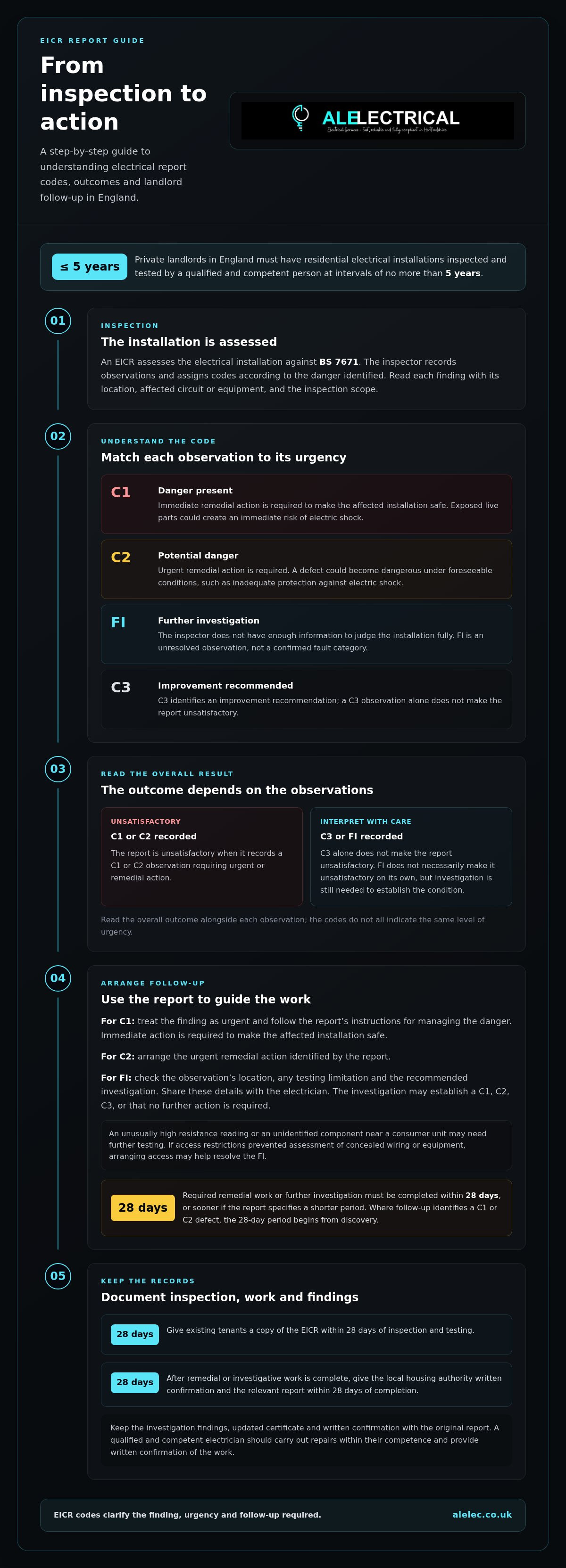
An EICR is required at regular intervals for private landlords in England: according to UK legislation, electrical installations must be inspected and tested at intervals of no more than 5 years. Understanding your EICR report codes helps you see what an inspector has found and what action may be needed. C1 means danger is present and immediate remedial action is required, while FI means further investigation is needed.
It’s understandable to find the codes and the final result difficult to interpret at first. This guide explains when an inspection is needed, what C1 and FI mean, and how observations affect whether a report is satisfactory or unsatisfactory, so you can understand the next steps for the property.
Table of Contents
C1 code: danger present and immediate remedial action
An EICR assesses an electrical installation against the BS 7671 wiring regulations, according to BSI. The inspector records observations and assigns codes according to the danger identified. C1 means danger is present, so immediate action is required to make the affected installation safe. For example, exposed live parts could create an immediate risk of electric shock. Treat a C1 finding as urgent, not as a routine improvement, and follow the report’s instructions for managing the danger.
C2 means potential danger and requires urgent remedial action. It may describe a defect that could become dangerous under foreseeable conditions, such as inadequate protection against electric shock. Both C1 and C2 findings make an EICR unsatisfactory until the relevant work is completed. Read each observation carefully: the report should identify the affected circuit or equipment and explain the issue, helping the electrician determine what needs attention.
In England, UK legislation requires landlords to ensure required remedial work or further investigation is completed within 28 days, or sooner if the report specifies a shorter period. A qualified and competent electrician should carry out repairs within their competence and provide written confirmation of the work. Landlords must give existing tenants a copy of the EICR within 28 days of inspection and testing, according to UK legislation. After remedial or investigative work, landlords must also give the local housing authority written confirmation and the relevant report within 28 days of completion.
UK legislation requires private landlords in England to have residential electrical installations inspected and tested by a qualified and competent person at intervals of no more than 5 years. How much do repairs cost? The price depends on the fault, access, parts and extent of work, and is given after a quote request. If the electrician identifies further defects during repair, they should explain the additional work and record the outcome clearly.
FI further investigation
An FI code means further investigation is needed because the inspector lacks enough information to judge the electrical installation fully. It identifies an unresolved observation, not a confirmed fault category. The follow-up investigation should establish whether the issue is C1, C2, C3, or no further action is required. Arrange it promptly, particularly if the report describes a potentially dangerous condition.
For example, an unusually high resistance reading may need further testing to identify its cause. An unidentified component near a consumer unit may also receive FI if its purpose or condition cannot be established during the inspection. The electrician can examine the relevant circuit, carry out suitable tests and record the finding. This evidence helps determine whether remedial work is needed and what it should address.
Check the report for the location of the observation, any testing limitation and the recommended investigation. Give this information to the electrician carrying out the follow-up so they can focus on the affected part of the installation. If concealed wiring or equipment could not be assessed because access was restricted, arranging access may be part of resolving the FI. A landlord should keep the investigation findings and any updated certificate with the original report.
For landlords in England, if follow-up work identifies a C1 or C2 defect, the 28-day period for required remedial work begins from discovery. The electrician should document the outcome and provide written confirmation of completed work where applicable. If an FI relates to a proposed charger circuit, investigation can clarify its condition before installation; EV charger installation is relevant when that is the work being planned.
Satisfactory and unsatisfactory EICR outcomes
The overall result on an electrical installation condition report reflects its observations and the agreed inspection scope. The code beside each finding helps explain whether action is needed.
How codes shape report outcomes
A report is unsatisfactory when it records a C1 or C2 observation requiring urgent or remedial action. C3 identifies an improvement recommendation, and a C3 observation alone does not make the report unsatisfactory. An FI observation does not necessarily make the report unsatisfactory on its own. FI still means an investigation is needed to establish the installation’s condition. Read the outcome alongside each observation, rather than treating every listed issue as equally urgent.
Responding to unsatisfactory findings
Start by matching each code to the report’s description of the wiring, location and recommended remedial action. Arrange the work or investigation needed, then keep the written record of what was completed. If you disagree with a code, ask the inspector to explain the observation and the reasoning behind its classification. This gives you a clear basis for discussing the report or requesting a review. For help addressing electrical findings, arrange electrical maintenance.
Landlord duties after an unsatisfactory report
In England, landlords must ensure required remedial work or further investigation is completed within 28 days, or within a shorter period specified in the report, according to UK legislation. Once that work is complete, landlords must provide the local housing authority with written confirmation and the relevant report within 28 days. Keep these records with the EICR. They show what action followed each finding and help demonstrate that the electrical installation’s condition was addressed.
ALElectrical: House Rewires
ALElectrical carries out House Rewires when an inspection identifies widespread wiring concerns that may require more than isolated remedial work. A rewire may be appropriate if the report records multiple issues across the electrical installation. If a finding relates specifically to the fuse box, a Fuse Box Upgrade may be more suitable. The work needed depends on the recorded observations and the condition of the affected parts of the property.
Once you understand the report, ALElectrical can help you consider work that fits its findings, including Solar & Battery where relevant to your project. Contact ALElectrical to discuss your report and request a free, no-obligation quote, or visit alelec.co.uk.
Turn your report into a clear next step
Understanding your EICR report codes is useful when it helps you plan what to do next, rather than simply file the report away. Consider whether the findings point to a focused repair, broader work on the property or advice before another electrical project. Keeping the report and remedial-work records together can also help you plan future maintenance.
ALElectrical can help with the work that follows an electrical assessment, including House Rewires, Fuse Box Upgrades and Solar & Battery projects. The right option depends on the findings and the needs of your property. If you’re ready to discuss your EICR and possible next steps, contact ALElectrical about your EICR. A clear conversation can help you move forward with confidence.
Frequently Asked Questions
When is an EICR Needed?
An EICR is needed according to the property’s use and electrical safety requirements. In England, private landlords must arrange inspection and testing at intervals of no more than 5 years. Homeowners are generally advised to arrange an inspection at least every 10 years, whilst businesses are strongly advised to obtain one at least every five years. An inspection may also help assess an older property or electrical installation after alterations.
Why are EICR Codes Important?
EICR codes indicate the priority and type of action associated with each observation. Understanding your EICR report codes means reading each code alongside the inspector’s description, not in isolation. That detail helps landlords, homeowners and electricians discuss the finding and plan suitable work. For example, an improvement recommendation is different from a defect requiring urgent attention.
Do domestic rented EICR rules differ across the UK?
Yes, landlord electrical safety requirements are not identical across the UK. The requirement for private landlords to arrange inspections at intervals of no more than 5 years applies in England. If you rent out a property in Scotland, Wales or Northern Ireland, don’t assume England’s rules apply. Identify which nation the property is in, then follow the electrical safety requirements that govern rented homes there.
What does an electrical safety check involve?
An electrical safety check involves inspecting and testing the fixed electrical installation, not simply checking whether lights and sockets work. Understanding your EICR report codes also means looking at what was inspected and noting any access limitations. The electrician records observations about wiring, circuits and protective devices. For instance, concealed wiring may not be accessible for examination during the assessment.
What happens if I don’t address C1 or C2 codes?
Leaving a C1 or C2 issue unresolved can mean a dangerous or potentially dangerous defect remains in use, putting people and property at risk. In England, landlords must complete required remedial work or further investigation within the report’s deadline. From 1 November 2025, local authorities may impose a financial penalty of up to £40,000 for a landlord’s breach of electrical safety duties, according to UK legislation.


Comments